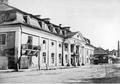
Sokol Society at Former Hecht Casino
The idea of creating a gymnastics society first appeared in 1866; already in the spring of the following year, the founding meeting of “Sokil” took place in…
Read more
The idea of creating a gymnastics society first appeared in 1866; already in the spring of the following year, the founding meeting of “Sokil” took place in…
Read more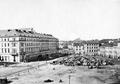
A view of the ancient Krakow Market; one of the oldest (1570) and longest Lviv streets (8 km) – Horodotska – begins here. On the left is the majestic building…
Read more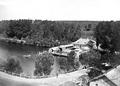
Pelczyński pond was located at the foot of Poznańska Mountain as early as the 16th century and was owned by the Pelków family, hence its name. On the…
Read more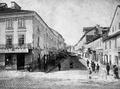
The newest appearance of the ancient Sixtus or Sixtus Road, known since 1535, is now Doroshenka Street. As a city street, it was formed around the middle of…
Read more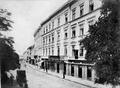
A rather rare view of the central Lviv street is the perspective of Hetmanska Street. On the left and now stretches a city square, which now has no name, once…
Read more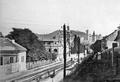
The street has had this name for 140 years. It was known since 1560 as Sokilnytska Doroga or Sokilnytskyi Shlyach, since 1690 it has been Shyroka Street (its…
Read more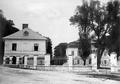
The palace of Vincenta Skryński, the founder and funder of the school for the blind in Lviv, was located approximately where Tekhnichna and Ustyyanovycha…
Read more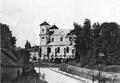
The photograph shows the beginning of Novyi Svit (S. Bandery) Street at its junction with Sikstuska (Doroshenko) Street in the district of the same name. The…
Read more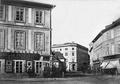
The Hotel “d’Angleterre” – “The English” – began operating in 1840 in a building on the corner of Pojezuitska (V. Hnatyuka) and Nyzhni Valiv (Svobody Avenue).…
Read more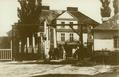
The photograph presents a view of the former Celecki Palace on the Zhovkva turnpike, where Leib Bacheles (Baczewski) settled and situated his famous spirits…
Read more
Krakowska Square appeared around 1840 between Krakivska, Teatralna Streets, Golukhovskych Square, Rizni, Gusiacha, Smocha, Zhovkivska Streets. It got its name…
Read more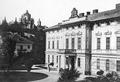
Palace of Count Agenor Gołuchowski, erected on Sviatyi Yuryi (Swięty Jur) Street (now Lystopadovyi Chyn 16) in 1865. Planned by the architect Carl Ohmann, it…
Read more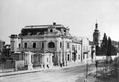
Neo-baroque palace in Kopernika Street 40, built in 1867 by the architect Adolph Kuhn for prince Leon Sapieha, who, after his return from emigration in Paris…
Read more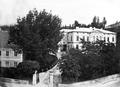
The photograph shows the Dzieduszycki palace on Kurkova (now: Lysenka) Street No. 15-17, built in the second half of the 19th century. Building no. 15…
Read more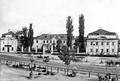
Former palace of the Bielski, Potocki, Komorowski, Uleniecki and Biesiadecki families on Halytska Square 10, built (or rebuilt from a previous building) by the…
Read more