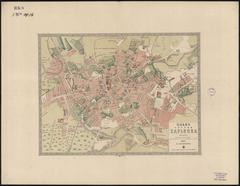
Map of the City of Kharkov
- ID: 34570
- Place: Kharkiv


This map of Chernivtsi shows the territory of the city in the late nineteenth century.
The map is not dated. A publication by L. West dates it to 1888 [63], p. 20. 1891-1894 can be considered the outside date,as that is when the new Jesuit Church was built in the territory, marked on the map as Projektirter Stadttheil ("Prospective development").
The plan was drawn by the City Construction Engineer Ludwig West.
The plan was printed to order of Andreas Juszyński. The graphical execution and printing were carried out by the Eduard Hölzel's Geographical Institute in Vienna.
Legend:
Map Characterization:
Map Toponymics:
The map's toponymics comprises about 245 objects:
Inconsistencies and inaccuracies on the map:
Characterization of the City:
The map shows the city of Chernivtsi at the beginning of its heyday – in the last quarter of the nineteenth century.
Among the most important new buildings of this period, are: the Armenian Church (1875), the Tempel (1877), the Monument to Austria (1875), the City Theater at the corner of Turetska and Shkilna Streets (1877), the Music Society (1877), the Teachers' Seminary (Pädagogium, 1880s), the ensemble of buildings of the Residence of the Metropolitans of Bukovina and Dalmatia (1882), the Institute for Natural Sciences (1883), the Industry School (1882-1884), and the People's School (1887).
In 1887, while on a visit to Chernivtsi, the Emperor's son, Crown Prince Rudolph, said: "I am very happy to be able to spend tomorrow in this beautiful city" [66], p. 99
As of 1880, the city's population comprised about 44,600 people. This included 11,271 Germans, 11,271 Jews, 8,232 Ruthenians, 6,431 Romanians, 6,707 Poles (including Greek (Eastern-rite) Catholics), and 510 people of other ethnicities.
The city's religious makeup was: Roman Catholic – 13,376; Greek Catholic – 5,656; Evangelical – 2,200; Orthodox – 9,650; Jews – 11,499, and others (Armenian Catholic, Armenian Apostolic, and Lipowan Old Believers) – 301.
As of 1880, the city had 4,414 buildings [66], p. 254
Entry by: Ihor Siomochkin Translated by: Pavlo Hrytsak